L&F Tax & Bookkeeping Services
  • Home
  • How We Work With Clients
  • Client Portal
  • Contact
  • More
    • Tax Due Dates
    • Tax Return Deadlines & Preparation Process
    • Individual Income Tax Return Checklist
    • Business Tax Return Checklist
    • Starting Your Business
    • Accounting & Bookkeeping Services
    • Payroll Services
    • Fiscal Management & Board Support Services for Self-Managed Homeowners Associations & Apartment Owners Associations
    • Board of Directors Survival Guide
    • AOAO Board of Director Resource Center
    • Document Submission Guidelines
    • Communication & Appointments
    • Frequently Asked Questions
    • Tax Newsline

Tax Newsline

Our newsline provides the latest news from the IRS, due dates, reminders, and thoughtful insights on accounting and tax related topics

IRS Raises Standard Mileage Rate to 70 Cents Per Mile in 2025

12/19/2024

 
The Internal Revenue Service today announced that the optional standard mileage rate for automobiles driven for business will increase by 3 cents in 2025, while the mileage rates for vehicles used for other purposes will remain unchanged from 2024. 

Beginning Jan. 1, 2025, the standard mileage rates for the use of a car, van, pickup or panel truck will be: 


  • 70 cents per mile driven for business use, up 3 cents from 2024.
  • 21 cents per mile driven for medical purposes, the same as in 2024.
  • 21 cents per mile driven for moving purposes for qualified active-duty members of the Armed Forces, unchanged from last year.
  • 14 cents per mile driven in service of charitable organizations, equal to the rate in 2024. 
ALERT:  IRS warns taxpayers about misleading claims about non-existent “Self Employment Tax Credit;” promoters, social media peddling inaccurate eligibility suggestions

7/15/2024

 
Taxpayers urged to talk to a trusted tax professional, not rely on marketers or social media for tax advice

IR-2024-187, July 15, 2024

WASHINGTON — The Internal Revenue Service issued a consumer alert today following bad advice circulating on social media about a non-existent “Self Employment Tax Credit” that’s misleading taxpayers into filing false claims.

Promoters and social media are marketing something they describe as the “Self Employment Tax Credit” as a way for self-employed people and gig workers to get big payments for the COVID-19 pandemic period. Similar to misleading marketing around the Employee Retention Credit, there is inaccurate information suggesting many people qualify for the tax credit and payments of up to $32,000 when they actually do not.
​

In reality, the underlying credit being referred to in social media isn’t called the “Self Employment Tax Credit,” it’s a much more limited and technical credit called Credits for Sick Leave and Family Leave. Many people simply do not qualify for this credit, and the IRS is closely reviewing claims coming in under this provision so people filing claims do so at their own risk.

“This is another misleading social media claim that’s fooling well-meaning taxpayers into thinking they’re due a big payday,” said IRS Commissioner Danny Werfel. “People shouldn’t be misled by outlandish claims they see on social media. Before paying someone to file these claims, taxpayers should consult with a trusted tax professional to see if they meet the very limited eligibility scenarios.” 

People who were self-employed can claim Credits for Sick and Family Leave only for limited COVID-19 related circumstances in 2020 and 2021; the credit is not available for 2023 tax returns. The IRS is seeing repeated instances where taxpayers are incorrectly using Form 7202, Credits for Sick Leave and Family Leave for Certain Self-Employed Individuals, to incorrectly claim a credit based on income earned as an employee and not as a self-employed individual.

To qualify for the Sick and Family Leave Credits, self-employed workers have to meet a variety of technical reasons in 2020 and 2021 that didn’t allow them to work, including caring for an individual subject to a quarantine or isolation order. The IRS has a detailed set of FAQs describing the very technical requirements for meeting this provision of the law.

The IRS is seeing some similarities to marketing around this “Self Employment Tax Credit” similar to aggressive promotion of the Employee Retention Credit. Both are technical credits that have been mischaracterized by some as a way for average taxpayers to get a big government payment. In reality, these are very limited credits that have a variety of complex requirements before people can qualify.

The IRS urges people to check with a trusted tax professional before filing for any “Self Employment Tax Credit” or any other questionable tax claim circulating on social media.

The IRS has previously warned taxpayers about misuse of the Sick and Family Leave Credits stemming from various tax scams and inaccurate social media advice that led thousands of taxpayers to file inflated refund claims during the past tax season.

In addition to the Sick and Family Leave Credit, the IRS warned taxpayers not to fall for these scams centered around the Fuel Tax Credit and household employment taxes. The IRS has seen thousands of dubious claims come in where it appears taxpayers are claiming credits for which they are not eligible, leading to refunds being delayed and the need for taxpayers to show they have legitimate documentation to support these claims.

The IRS continues to urge taxpayers to avoid these scams as myths continue to persist that these are ways to obtain a huge refund. Many of these scams were highlighted during this spring’s annual Dirty Dozen series, including the Fuel Tax Credit scam, bad social media advice and “ghost preparers.”

“These improper claims have been fueled by social media and people sharing bad advice,” Werfel said. “Scam artists constantly prey on people’s hopes and try to use the complexity of the tax system to convince people there are secret ways to get a big refund. All of these scams illustrate that it’s important to carefully review the tax return for accuracy before filing and rely on the advice of a trusted tax professional, not someone trying to make a quick buck or a questionable source on social media.”

Source

Misleading Social Media Advice Leads to False Refund Claims

7/8/2024

 
Misleading social media advice leads to false claims for Fuel Tax Credit, Sick and Family Leave Credit, household employment taxes; FAQs help address common questions, next steps for those receiving IRS letters

The Internal Revenue Service issued alert IR-2024-139 about a series of scams and inaccurate social media advice. Social media schemes led to thousands of inflated refund claims during the past tax season. The IRS has increased its compliance efforts related to false and/or questionable credits. 

These FAQs are being issued to provide general information to taxpayers and tax professionals as expeditiously as possible. Accordingly, these FAQs may not address any particular taxpayer’s specific facts and circumstances, and they may be updated or modified upon further review. 

Background
The IRS warns taxpayers not to fall for these scams centered around the Fuel Tax Credit, the Sick and Family Leave Credit, household employment taxes and overstated withholding. The IRS has seen thousands of dubious claims come in where it appears taxpayers are claiming credits for which they are not eligible, leading to refunds being delayed and the need for taxpayers to show they have legitimate documentation to support these claims. 

The IRS continues to urge taxpayers to avoid these scams as myths continue to persist that these are ways to obtain a huge refund.

The IRS reminds taxpayers to keep these important points in mind: 
  • Social media can connect people and information from all over the globe. Unfortunately, sometimes people provide bad tax advice that can lure good taxpayers into trouble.
  • The IRS warns taxpayers to be wary of trusting internet advice, whether it’s a fraudulent tactic promoted by scammers or a deliberately false tax-related scheme trending across popular social media platforms.
  • The IRS is aware of various filing season hashtags and social media topics related to this fraudulent information. These generally involve people trying to use legitimate tax forms for the wrong reason. 

Continue Reading at IRS.gov

IRS further extends tax relief for Maui wildfire victims

3/29/2024

 
The Internal Revenue Service today further postponed until Aug. 7, 2024, various tax-filing and tax-payment deadlines for individuals and businesses affected by the Aug. 8, 2023, wildfires in Hawaii. Previously, the deadline was Feb. 15, 2024.

IRS News Release

IMPORTANT NOTE:  Hawaii tax returns are still due on the usual dates.  Hawaii has not complied with this extension.  

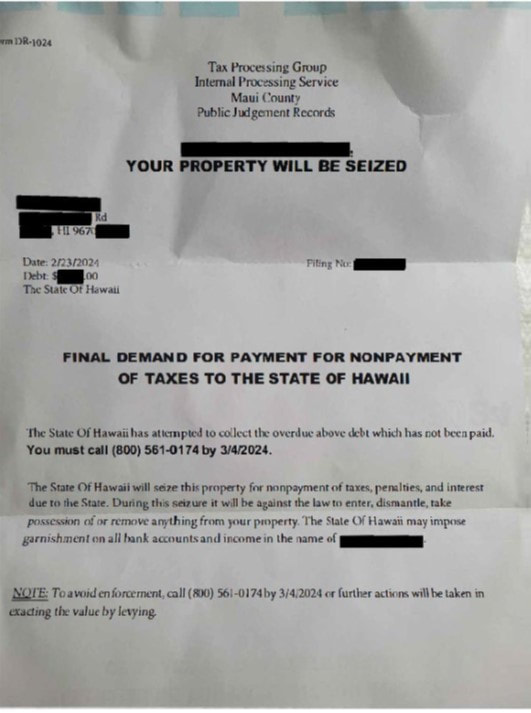
Hawaiʻi Department of Taxation Warns Taxpayers About Tax Enforcement Scam

3/18/2024

 
HONOLULU – It’s tax season and fraudsters are looking to target taxpayers. The Hawaiʻi Department of Taxation (DOTAX) is cautioning taxpayers about activity involving tax-related scams, including this recent attempt​.
Picture

Hawaii Mandatory Electronic Filing of Withholding Returns for Employers

12/22/2023

 
Pursuant to section 231-8.5, Hawaii Revised Statutes (HRS), the Department of Taxation 
("Department") requires the electronic filing of withholding tax filings for employers whose 
withholding tax liability exceeds $40,000 annually. Pursuant to section 231-9.9, HRS, the 
Department may also require electronic filing for any person who is required to electronically 
file a federal return. 
Hawaii Department of Taxation Announcement 2023-07​

GE Tax for Maui County to Increase to 4.5% on 1/1/2024

10/24/2023

 
GE Tax for Maui County will increase to 4.5% (retail & services) effective January 1, 2024.  Please be prepared to update your tax charged to customers/clients/guests accordingly on January 1st.  


  1. Retail & Services: The tax to charge customers/clients/guests for GE is 4.712%.  You will pay 4.5% on the gross income & taxes collected on your GE tax return.  
  2. Wholesale & Subcontracting: The wholesale rate will remain at .5% with no increase.
  3. Those of you with transient accommodations will now be passing on $17.962% (4.712% GE, 10.25% TAT, & 3% MCTAT).

More information on GE tax increase:  https://files.hawaii.gov/tax/news/announce/ann23-05.pdf

What You Need to Know About the Corporate Transparency Act

10/24/2023

 
Key Points

  • If your business is registered with state as a partnership, LLC, corporation, or other entity you may be impacted by a new law called the Corporate Transparency Act (CTA) that has Beneficial Ownership reporting requirements.
 
  • Exempt businesses include those with at least 20 full time employees, federally regulated businesses, and sole proprietors who are NOT registered with the State.  It is unclear at this point whether trade names will qualify a sole proprietor for reporting.
 
  • The CTA requires businesses to report beneficial ownership information (BOI) to the Financial Crimes Enforcement Network (FinCEN), an agency within the U.S. Treasury Department.
 
  • The business will be required to submit an electronic form that includes the following information:
    • A name, address, birth date, and a unique ID number for each beneficial owner (a driver’s license number or passport number)
    • A name, address, registered agent, and tax ID number for the business
    • Type of BOI filing (initial filing, correction, or update)
    • For newly created businesses, information about company applicants (more on this in the next section)
 
  • FinCEN beneficial ownership information will only be available to authorized law enforcement agencies and financial institutions.
 
  • Due Dates:
    • For businesses registered prior to January 1, 2024, the report is due by January 1, 2025.
    • For businesses created on or after January 1, 2024, the report will be due within 30 days from the time the business receives notice that its registration is approved by the state.
    • Additional reports are required only when there is a change to the information provided, such as a change in ownership or correcting an error.
 
  • Penalties:
    • There are penalties for failure to comply and providing false information of $500 per day ($10,000 max) and up to 2 years in prison.
    • The penalty for anyone with access to this information disclosing it without proper authorization is a fine of $500 per day up to $25,000 and up to 5 years in prison. 
 
  • The reporting portal is expected to be ready to accept reports on January 1, 2024. 

IRS provides guidance on employer leave-based donation programs that aid victims of the wildfires in Hawaii

9/28/2023

 
WASHINGTON — The Internal Revenue Service today provided guidance for employers whose employees forgo sick, vacation or personal leave to aid victims of the wildfires that began in parts of Hawaii on Aug. 8, 2023.

Notice 2023-69PDF provides that cash payments employers make to charitable organizations during 2023 and 2024 providing relief to victims of the wildfires in Hawaii in exchange for sick, vacation or personal leave which their employees forgo will not be treated as compensation. Similarly, the employees will not be treated as receiving the value of the leave as income and cannot claim a deduction for the leave that they donated to their employer.

Employers, however, may deduct these cash payments as a business expense or as a charitable contribution deduction if the employer otherwise meets the respective requirements of the applicable sections of the Internal Revenue Code.

Notice 2023-69PDF provides further details for employers with leave donation programs.

Additional information about tax relief for those affected by the wildfires in Hawaii is available at IRS.gov.

IRS provides guidance on employer leave-based donation programs that aid victims of the wildfires in Hawaii

To protect taxpayers from scams, IRS orders immediate stop to new Employee Retention Credit processing amid surge of questionable claims; concerns from tax pros, aggressive marketing to ineligible applicants highlights unacceptable risk to businesses and

9/14/2023

 
Moratorium on processing of new claims through year’s end will allow IRS to add more safeguards to prevent future abuse, protect businesses from predatory tactics; IRS working with Justice Department to pursue fraud fueled by aggressive marketing.

WASHINGTON – Amid rising concerns about a flood of improper Employee Retention Credit claims, the Internal Revenue Service today announced an immediate moratorium through at least the end of the year on processing new claims for the pandemic-era relief program to protect honest small business owners from scams.

IRS Commissioner Danny Werfel ordered the immediate moratorium, beginning today, to run through at least Dec. 31 following growing concerns inside the tax agency, from tax professionals as well as media reports that a substantial share of new claims from the aging program are ineligible and increasingly putting businesses at financial risk by being pressured and scammed by aggressive promoters and marketing.

The IRS continues to work previously filed Employee Retention Credit (ERC) claims received prior to the moratorium but renewed a reminder that increased fraud concerns means processing times will be longer. On July 26, the agency announced it was increasingly shifting its focus to review these claims for compliance concerns, including intensifying audit work and criminal investigations on promoters and businesses filing dubious claims. The IRS announced today that hundreds of criminal cases are being worked, and thousands of ERC claims have been referred for audit.

The IRS emphasizes that payouts for these claims will continue during the moratorium period but at a slower pace due to the detailed compliance reviews. With the stricter compliance reviews in place during this period, existing ERC claims will go from a standard processing goal of 90 days to 180 days – and much longer if the claim faces further review or audit. The IRS may also seek additional documentation from the taxpayer to ensure it is a legitimate claim.

This enhanced compliance review of existing claims submitted before the moratorium is critical to protect against fraud but also to protect the businesses from facing penalties or interest payments stemming from bad claims pushed by promoters, Werfel said.

“The IRS is increasingly alarmed about honest small business owners being scammed by unscrupulous actors, and we could no longer tolerate growing evidence of questionable claims pouring in,” Werfel said. “The further we get from the pandemic, the further we see the good intentions of this important program abused. The continued aggressive marketing of these schemes is harming well-meaning businesses and delaying the payment of legitimate claims, which makes it harder to run the rest of the tax system. This harms all taxpayers, not just ERC applicants.”
​

“For those people being pressured by promoters to apply for the Employee Retention Credit, I urge them to immediately pause and review their situation while we look to add new protections and safeguards to stop bad claims from ever coming in,” Werfel said. “In the meantime, businesses should seek out a trusted tax professional who actually understands the complex ERC rules, not a promoter or marketer hustling to get a hefty contingency fee. Businesses that receive ERC payments improperly face the daunting prospect of paying those back, so we urge the utmost caution. The moratorium will help protect taxpayers by adding a new safety net onto this program to focus on fraudulent claims and scammers taking advantage of honest taxpayers.”

More:  
To protect taxpayers from scams, IRS orders immediate stop to new Employee Retention Credit processing amid surge of questionable claims; concerns from tax pros | Internal Revenue Service

<<Previous
Forward>>

    Archives

    July 2026
    September 2025
    August 2025
    July 2025
    December 2024
    July 2024
    March 2024
    December 2023
    October 2023
    September 2023
    August 2023
    July 2023
    June 2023
    May 2023
    April 2023
    December 2022
    October 2022
    September 2022
    August 2022
    July 2022
    June 2022
    December 2021
    May 2021
    April 2021
    March 2021
    December 2020
    April 2020
    March 2020
    December 2019
    November 2019
    August 2019
    July 2019
    March 2019
    January 2019
    November 2018
    October 2018
    September 2018
    May 2018
    December 2017
    November 2017
    October 2017
    August 2017
    July 2017
    June 2017
    May 2017
    April 2017
    March 2017
    February 2017
    December 2016
    November 2016
    October 2016
    September 2016
    August 2016
    June 2015

Copyright © 2019   L&F Tax & Bookkeeping Services, LLC